
Industrial electrical cabinet cooling
Thermoelectric Cabinet Coolers and Air Cooling Modules
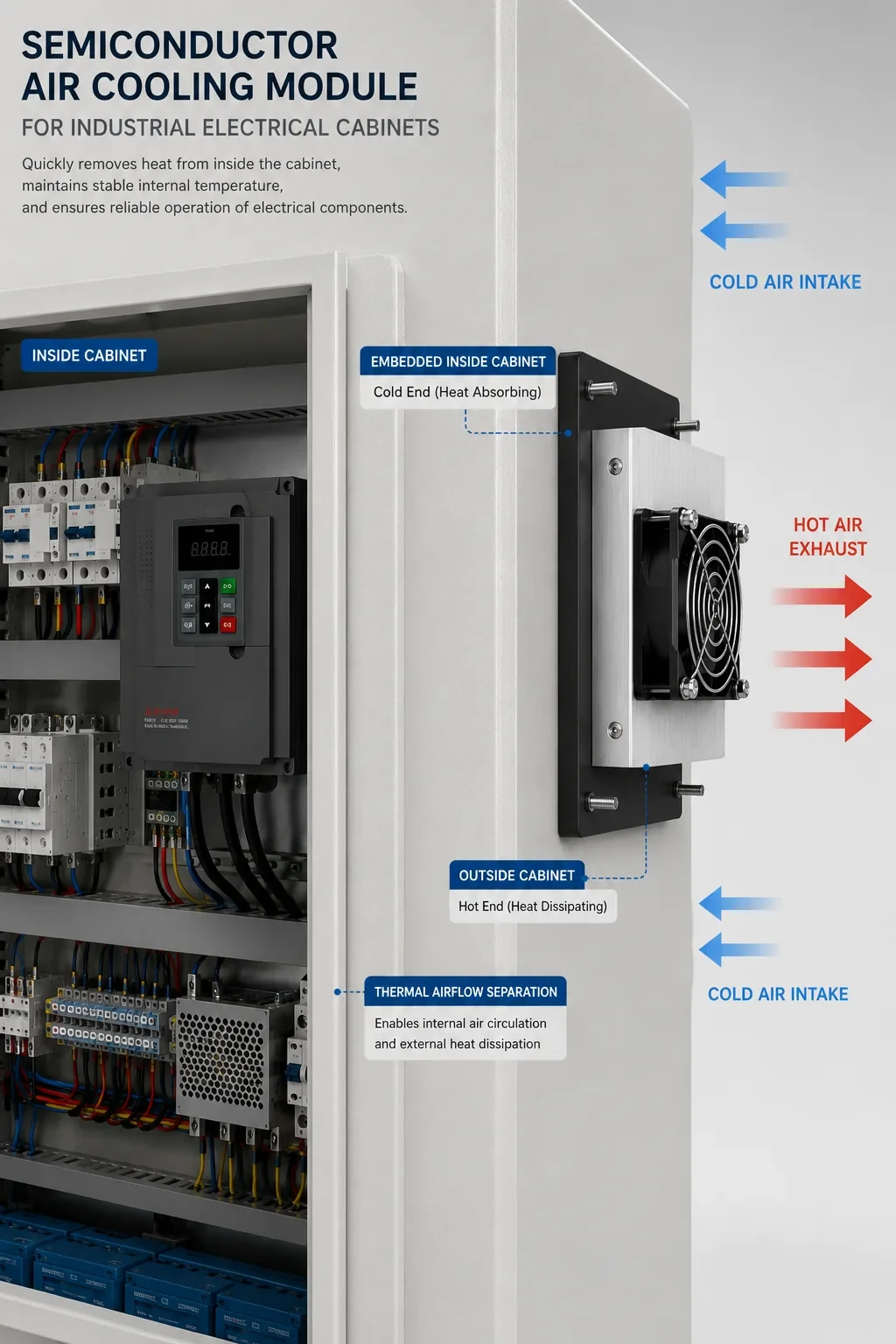
Industrial electrical cabinets concentrate PLCs, variable-frequency drives, power supplies, relays, contactors, communication modules and other heat-producing electronics inside a limited enclosure. A thermoelectric cabinet cooler, also described as a thermoelectric air cooling module or Peltier cabinet cooler, transfers this heat through the cabinet wall while keeping the internal and external air paths separated, helping maintain a controlled cabinet temperature without a compressor or refrigerant circuit.
Reliability risk
Why temperature control matters inside an industrial electrical cabinet
Electrical losses become heat. Even when every component operates below its individual rated temperature, accumulated cabinet heat can raise local air and surface temperatures around densely installed devices.
Repeated high-temperature exposure accelerates insulation ageing, increases semiconductor stress, reduces power-supply margin and can trigger derating or protective shutdown. Stable enclosure temperature therefore supports reliability, measurement consistency and predictable maintenance.
Variable-frequency drives and servo drives
Power semiconductors and DC-link components generate continuous heat. High inlet-air temperature can reduce available output or cause overtemperature alarms.
PLCs, I/O and communication modules
Elevated or uneven temperature can affect processor stability, analogue accuracy, communication reliability and module life.
Power supplies, relays and contactors
Losses in transformers, coils, contacts and converters add to the cabinet heat load and can create local hot spots.
Seals, terminals and wiring insulation
Long-term heat exposure can age polymer materials, loosen electrical margins and shorten planned service intervals.
Working principle
How a thermoelectric air cooling module cools the cabinet
The module is installed through a cabinet wall or door. Its cold-side heat sink and fan face the protected interior, while its hot-side heat sink and fan remain outside. DC current drives the Peltier elements between the two sides, pumping heat from the cold side to the hot side.
Internal warm air returns to the cold side
A cabinet-side fan draws warm internal air across the cold-side heat exchanger. The air releases sensible heat and returns to the enclosure at a lower temperature.
Peltier elements pump heat through the wall
The semiconductor stage absorbs heat at its cold surface and releases it at the hot surface. Thermal interface quality and clamping pressure influence this transfer.
The external heat sink rejects total heat
The hot side must remove both the cabinet heat pumped by the module and the electrical input consumed by the TEC. External intake and exhaust must remain unobstructed.
Separated air paths preserve the enclosure
Internal air recirculates in a closed loop and does not intentionally mix with ambient factory air, supporting cleaner electronics and enclosure sealing.
Closed-loop airflow
Why separated internal and external airflow is valuable
A filter fan cools by exchanging cabinet air with the room. That can be effective when ambient air is cool and clean, but it also introduces dust, oil mist, humidity or corrosive contaminants unless filtration and positive-pressure design are carefully maintained.
A thermoelectric enclosure cooler creates two independent air circuits. The cabinet-side circuit recirculates protected air; the ambient-side circuit removes heat. Proper gasketing around the wall opening is essential, because a leak can bypass this separation and compromise both thermal performance and enclosure protection.
This closed-loop cabinet cooling approach is particularly useful for compact control enclosures, outdoor kiosks, machine-mounted cabinets and dusty production areas where limited cooling capacity is sufficient and environmental separation matters.
Thermal calculation
Estimate the electrical cabinet cooling load before selecting a module
The required cooling capacity is not equal to the total nameplate power of every installed device. Estimate the power actually converted to heat under the worst credible operating condition, then include heat transfer through the enclosure and an engineering margin.
Practical sizing relationship
Required cooling capacity ≈ internal electrical losses + enclosure heat gain − useful enclosure heat loss + design margin
01
Internal electrical losses
Use manufacturer loss data where available. For power electronics, consider real load, switching frequency, duty cycle and simultaneous operation—not only rated input power.
02
Ambient and target temperatures
If ambient temperature is above the desired internal temperature, the enclosure gains heat through its surfaces. If ambient is lower, the enclosure may naturally reject part of the internal heat.
03
Solar radiation and nearby equipment
Outdoor sun load, ovens, motors and hot process surfaces can raise the effective ambient temperature well above the measured room average.
04
Safety margin and fouling
Allow for component tolerance, ageing fans, dust on the external heat sink and uncertain duty cycles. Avoid excessive oversizing that drives needless sub-ambient cooling.
Selection checklist
Thermoelectric enclosure cooler selection checklist
| Design input | What to confirm | Why it matters |
|---|---|---|
| Cooling load | How many watts of heat are generated at peak and typical duty? | Defines the minimum usable cooling capacity at the design temperature difference. |
| Temperature conditions | What are maximum ambient, desired internal temperature and allowable fluctuation? | Determines ΔT and the real operating point of the TEC assembly. |
| Power supply | Is 12 VDC, 24 VDC or another stable DC source available? | Defines the electrical interface, current capacity, wiring and protection. |
| Cabinet construction | What are wall thickness, material, cut-out area, mounting position and enclosure rating? | Determines mechanical fit, sealing and heat leakage. |
| Airflow clearance | Can both fans intake and exhaust freely without short-circuiting hot air? | Protects hot-side performance and internal temperature uniformity. |
| Environment | Are dust, oil mist, humidity, salt, corrosive gas, vibration or outdoor exposure present? | Influences fan, coating, seal, fastener and validation choices. |
| Control and alarms | Is simple thermostat control enough, or are proportional control, monitoring and alarms required? | Defines sensors, controller, relay/driver and system interface. |
| Noise and service | What noise limit, fan life and maintenance access are acceptable? | Influences fan sizing, speed control and installation position. |
Mechanical integration
Installation and airflow design principles
Choose a structurally stable mounting zone
Confirm door or wall strength, internal clearance, cable routes and safe service access before making the cut-out.
Seal the full perimeter
Use a continuous gasket compatible with the environment. Tighten mounting hardware evenly so the seal is compressed without distorting the cabinet panel.
Keep cold and hot airflow independent
The cold end must face the cabinet and the hot end must face ambient. Prevent any opening that allows factory air to bypass into the enclosure.
Create a complete internal circulation path
Do not aim cold discharge directly into an immediate obstruction. Leave return-air space and guide air past the components with the highest thermal risk.
Protect external intake and exhaust clearance
Avoid recesses, adjacent walls or cable trays that recirculate hot exhaust into the intake. Consider guards without choking flow.
Wire for industrial service
Use correctly sized conductors, overcurrent protection, polarity control, grounding where required and strain relief. Keep power wiring away from sensitive signals.
Place sensors where they represent the controlled zone
A sensor beside the cold outlet can read lower than the cabinet average. Select a location based on the actual protected components and control objective.
Control and protection
Temperature control and condensation prevention
Setpoint strategy
For electronics protection, the objective is usually to keep the cabinet below a safe upper limit—not to make it as cold as possible. A practical setpoint reduces energy use and condensation risk.
Dew-point protection
Condensation can form if cold-side surfaces fall below the dew point of the cabinet air. Use humidity-aware limits where needed, insulate cold surfaces and avoid uncontrolled full-power operation.
Control method
On/off control can suit wide deadbands and stable loads. Proportional current control can reduce cycling and improve temperature stability when the application requires it.
Alarm and interlock
Monitor cabinet temperature and, for critical systems, hot-side temperature or fan status. An alarm gives the machine controller time to derate or stop safely after a cooling fault.
Technology comparison
Compare electrical enclosure cooling technologies
| Design input | Best suited for | Engineering strengths | Important limits |
|---|---|---|---|
| Thermoelectric air cooling module | Compact sealed or semi-sealed cabinets with low-to-moderate heat loads | No compressor or refrigerant, flexible mounting, separated airflow and precise DC control | Efficiency and capacity decline as temperature difference rises; hot-side airflow remains essential |
| Filtered fan ventilation | Clean environments where ambient is sufficiently cooler than the cabinet target | Simple, economical and efficient for appropriate conditions | Cannot cool below ambient and continuously introduces ambient air and contaminants |
| Compressor cabinet air conditioner | Higher heat loads and larger enclosures requiring active below-ambient cooling | Higher capacity and often better efficiency at larger loads | Larger, heavier, mechanically more complex and uses a refrigerant circuit |
| Air-to-air heat exchanger | Sealed cabinets where ambient is cooler than internal air | Separated air paths with no refrigerant and relatively low maintenance | Cannot reduce cabinet temperature below ambient; capacity depends strongly on temperature difference |
Application fit
When a Peltier cabinet cooler is—and is not—the right choice
Good application fit
- ✓Compact machine-control enclosures with a defined moderate heat load
- ✓Dusty, humid or oily areas where internal/external air separation is important
- ✓Outdoor or remote electronics with DC power and limited maintenance access
- ✓Localized cooling of PLC, drive, sensor, camera or communication zones
- ✓Applications needing low vibration, flexible orientation or accurate temperature control
Consider another cooling method
- !Large cabinets with several kilowatts of continuous heat
- !Sites with extremely high ambient temperature and a large required temperature difference
- !Poorly sealed enclosures with frequent door opening and uncontrolled moisture ingress
- !Installations where hot-side intake and exhaust cannot receive adequate airflow
- !Projects selected only from TEC Qmax without a system-level thermal calculation
Maintenance
Reliability and preventive maintenance
- 01Record normal cabinet, ambient and hot-side temperatures during commissioning.
- 02Inspect external heat-sink fins and remove dust or oil deposits before airflow is restricted.
- 03Check both fans for abnormal noise, vibration, slow start or alarm signals.
- 04Inspect the perimeter gasket, mounting fasteners, cable glands and drain provisions where used.
- 05Trend cabinet temperature so gradual performance loss is detected before an overtemperature shutdown.
- 06Confirm the sensor, controller, overcurrent protection and machine interlock during planned maintenance.
OEM project input
Information to provide for an OEM thermoelectric cabinet cooling project
Thermal data
Component losses, duty cycle, maximum ambient, target internal temperature, humidity and solar/process heat exposure
Mechanical data
Cabinet drawings, wall material and thickness, available cut-out, mounting orientation, airflow restrictions and service envelope
Electrical data
Available DC voltage/current, permitted input power, control signal, alarm interface, wiring and protection requirements
Environmental data
Dust, oil mist, water exposure, corrosion, altitude, vibration, shock, noise and expected operating life
Validation data
Temperature measurement points, acceptance limits, test duration, worst-case operating state and annual volume
Frequently asked questions
FAQ about thermoelectric air cooling modules for electrical cabinets
Can a thermoelectric air cooling module cool a sealed electrical cabinet?
Yes. Its internal and external airflow paths can remain separated when the wall cut-out and gasket are correctly designed. The usable cooling capacity must still exceed the calculated cabinet heat load at the maximum ambient temperature and required temperature difference.
Can a Peltier cabinet cooler cool below ambient temperature?
It can create a cold side below ambient, but the achievable cabinet temperature depends on heat load, insulation, leakage, hot-side temperature and module capacity. Below-dew-point operation also introduces condensation risk and requires specific protection.
How do I calculate the required electrical cabinet cooling capacity?
Add the real electrical losses of installed components, account for heat gained or lost through the enclosure, include solar or nearby process heat, then apply a justified design margin. Evaluate capacity at the actual ambient and target temperatures rather than using nominal Qmax alone.
Does a thermoelectric enclosure cooler need a filter?
The protected internal loop normally does not exchange air with the factory environment. The external side may still need a suitable guard or service strategy in dusty or oily locations, but any filter adds airflow resistance and must be included in the hot-side design.
What happens if the hot-side fan stops?
Hot-side temperature rises, TEC temperature difference and cooling capacity fall, and components can overheat. Critical installations should monitor temperature or fan status and provide an alarm, current limit or machine shutdown strategy.
Is thermoelectric cabinet cooling more efficient than compressor cooling?
Not universally. Thermoelectric systems are attractive for compact moderate loads, precise control, low vibration and refrigerant-free integration. Compressor systems are generally more suitable for larger loads. Compare both at the real operating point and total system requirements.
Technical reading
Related thermoelectric cooling resources
Need a thermoelectric air cooling module for an industrial cabinet?
Share your heat load, cabinet drawing, ambient range, target temperature, available DC power and environmental conditions. Arkmex Thermal can evaluate a standard or custom semiconductor air cooling module for your OEM enclosure.
Applications
Continue Reading
Explore more TEC cooling applications from Arkmex Thermal.