
Medical laser integration
How Thermoelectric Cooling Modules Are Applied in Medical Laser Systems
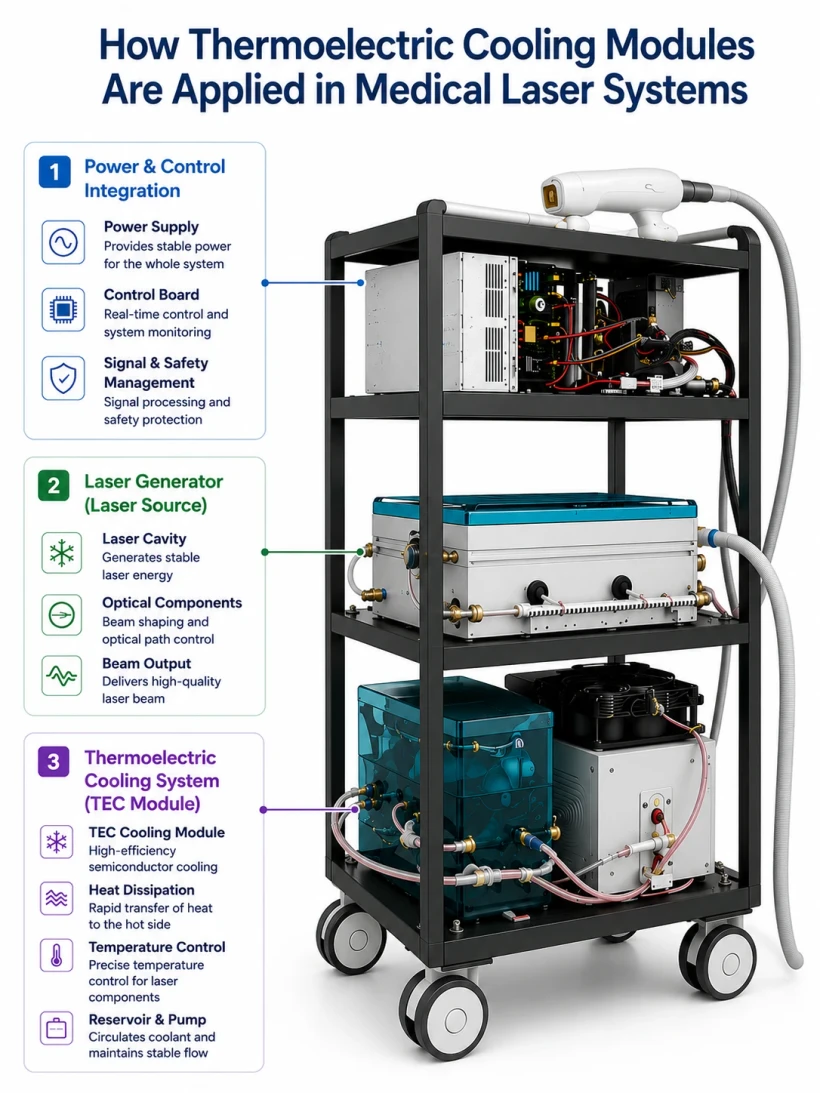
Medical laser equipment used in dermatology, aesthetic treatment, surgery, rehabilitation and diagnostic platforms must control heat in a compact internal space. Laser sources, power electronics, optical assemblies, handpieces and liquid loops all create thermal load that can affect output stability, patient comfort and equipment life.
Core engineering message
A custom thermoelectric cooling assembly helps medical laser systems maintain stable laser output, protect sensitive optical components, improve patient comfort and achieve compact embedded temperature control inside OEM equipment.
Thermal risks
Why medical laser systems need precision cooling
Laser energy is not fully converted into useful treatment energy. A significant portion becomes heat in the laser generator, diode array, cavity, cold plate, treatment head, power driver and control electronics.
If heat is not removed in time, the system may face wavelength drift, unstable output power, reduced beam uniformity, high temperature around power devices, uncontrolled treatment-head temperature, uncomfortable skin contact, protection shutdown or shortened component life.
Laser diodes require stable temperature to reduce wavelength drift and power decay.
Treatment handpieces and skin-contact tips need cooling to reduce thermal stimulation and improve treatment comfort.
Power supplies, driver boards and control boards need continuous heat dissipation for long operating sessions.
The cooling system must be compact, reliable and easy to integrate into limited equipment space.
Working principle and heat flow
How a thermoelectric cooling assembly works in a laser device
Thermoelectric cooling is based on the Peltier effect. When DC current passes through N-type and P-type semiconductor elements, one side absorbs heat and becomes the cold side, while the other side releases heat and becomes the hot side. In a medical laser system, the cold side may cool a laser diode base, treatment tip, optical plate or liquid loop. The hot side must reject heat through a heat sink, fan, cold plate or liquid circulation structure.
Architecture
Air-cooled TEC cooling assembly
A compact structure using a TEC element, cold plate, hot-side heat sink and fan. It is suitable for small and medium aesthetic laser devices, localized skin cooling, handpiece cooling and compact laser modules.
Architecture
Liquid-cooled TEC cooling assembly
A higher-capacity structure using liquid flow, pump, reservoir and heat exchange components. It is commonly used in diode laser platforms, IPL systems and long-duration treatment equipment.
Architecture
Embedded temperature control subsystem
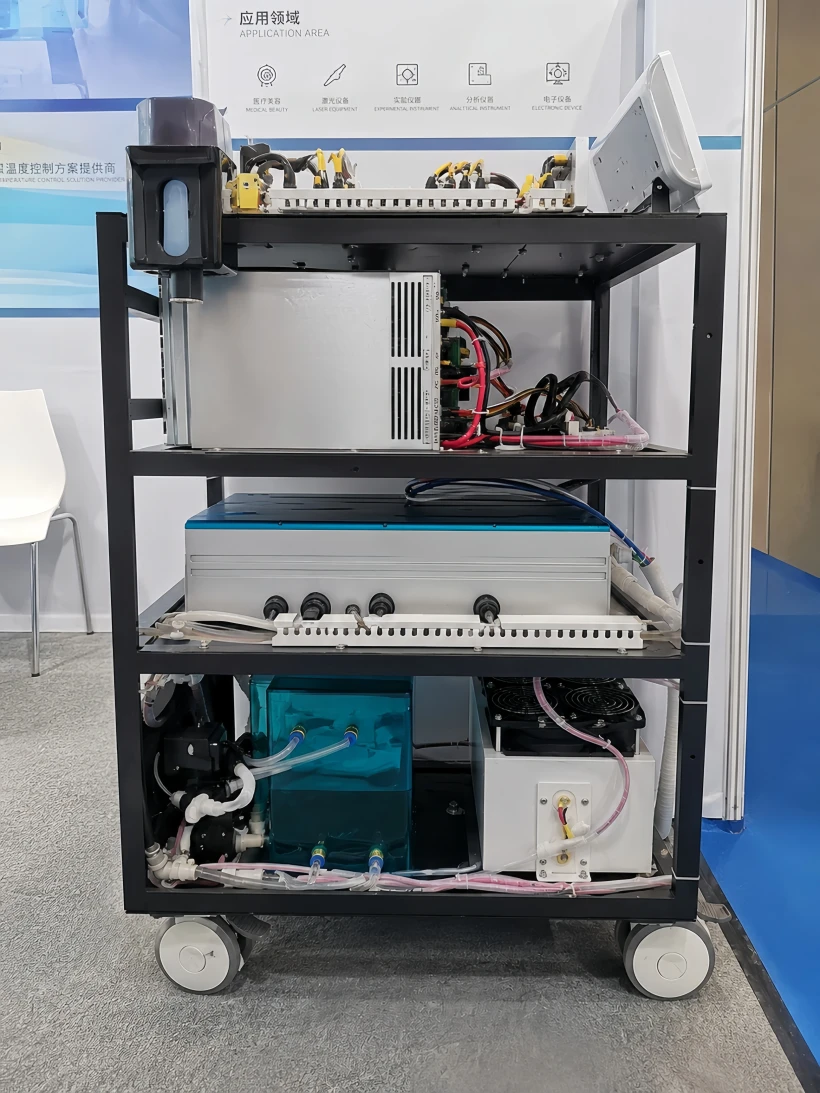
A complete compact TEC cooling system with sensors, controller, protection logic, wiring, liquid interface and mechanical mounting. This is usually what OEM medical laser manufacturers need for equipment integration.
Cooling object
Typical integration positions inside medical laser equipment
The cooling assembly can be placed at different points depending on whether the device needs laser-source stabilization, skin-contact cooling, liquid-loop cooling or electronics protection.
A custom thermoelectric cooling assembly helps medical laser systems maintain stable laser output, protect sensitive optical components, improve patient comfort and achieve compact embedded temperature control inside OEM equipment.
Medical laser integration
Near the laser source
Cooling object
Laser diode, laser cavity, optical components
Engineering goal
Stabilize output power and wavelength
Typical module form
TEC module + cold plate + temperature sensor
Medical laser integration
Treatment handpiece or cooling tip
Cooling object
Skin-contact surface, sapphire window, metal cold tip
Engineering goal
Improve comfort and control surface temperature
Typical module form
TEC + cold-side contact plate + hot-side dissipation
Medical laser integration
Liquid circulation system
Cooling object
Coolant, water tank, heat exchange block
Engineering goal
Lower coolant temperature for long operation
Typical module form
Liquid-cooled TEC cooling assembly
Medical laser integration
Power and control area
Cooling object
Power supply, driver board, power electronics
Engineering goal
Reduce internal temperature and improve reliability
Typical module form
Air-cooled or liquid-cooled thermal module
Design point
Key design points for medical laser cooling
Cooling capacity must match real heat load
Do not select only by the Qmax value of a TEC chip. Real performance depends on hot-side temperature, current, contact resistance, heat sink capacity, ambient temperature, mounting pressure and control strategy.
Hot-side heat rejection determines cold-side performance
If hot-side heat cannot leave the device, the cold side will rise quickly. Airflow direction, exhaust holes, heat sink size and liquid-loop design must be evaluated together.
Cold-side contact resistance must be controlled
Cold plates, sapphire windows, laser diode bases and heat exchange blocks need flat contact surfaces, proper thermal interface material and uniform locking pressure.
Temperature sensor placement affects control quality
Sensors should be close to the actual controlled object. Advanced systems may monitor cold side, hot side, liquid outlet, ambient and power electronics at the same time.
Condensation protection is part of the design
When cold-side temperature is below dew point, condensation can appear. Medical systems need temperature limits, insulation, drainage paths, PCB protection and software protection logic.
Engineering goal
What value TEC cooling brings to medical laser equipment
More stable laser output and lower risk of wavelength drift
Better skin-contact comfort for aesthetic treatment systems
Compact integration for mobile and embedded medical platforms
No compressor or refrigerant loop inside compact equipment
Precise closed-loop temperature control with sensors and controller
Improved reliability for laser, optical and power components
OEM confirmation
OEM project information needed for custom design
Arkmex Technology designs custom thermoelectric cooling assemblies, compact TEC cooling systems and embedded temperature control solutions for diode laser platforms, IPL devices, aesthetic laser handpieces and OEM medical equipment.
Target temperature
Information to provide
Cold-side target, liquid target and allowable fluctuation range
Impact on cooling design
Determines TEC size and control strategy
Heat load
Information to provide
Laser power, duty cycle and continuous working time
Impact on cooling design
Determines cooling capacity and hot-side heat rejection
Installation space
Information to provide
Length, width, height, mounting holes and internal structure
Impact on cooling design
Determines mechanical layout and airflow path
Cooling method
Information to provide
Air cooling, liquid cooling, mixed cooling and exhaust direction
Impact on cooling design
Determines hot-side design and noise level
Power conditions
Information to provide
Voltage, current, power margin and control interface
Impact on cooling design
Determines driver design and protection logic
Reliability requirements
Information to provide
Service life, ambient temperature, vibration and maintenance cycle
Impact on cooling design
Determines materials, testing and validation plan
Häufige Fragen
FAQ about TEC cooling assemblies for medical laser systems
Can a thermoelectric cooling module directly cool a medical laser source?
Yes, but it should be designed around the laser type, heat load, target temperature and available space. Most projects use an integrated TEC cooling assembly with a cold plate, sensor and hot-side heat dissipation.
Are TEC cooling assemblies suitable for high-power medical laser systems?
They can be suitable for selected high-power applications when hot-side heat rejection is strong enough. For higher thermal loads, a liquid-cooled thermoelectric cooling assembly is usually preferred.
How is condensation managed in medical laser cooling systems?
Condensation is managed through temperature limits, insulation, drainage design, PCB protection, humidity or temperature logic and software protection. It should be considered from the beginning of the thermal design.
What information is needed for a custom TEC cooling assembly?
Useful inputs include target temperature, ambient temperature, heat load, installation space, operating cycle, voltage, current, cooling target, interface direction, noise requirement and expected annual volume.
Need a custom TEC cooling assembly for a medical laser system?
Arkmex Technology designs custom thermoelectric cooling assemblies, compact TEC cooling systems and embedded temperature control solutions for diode laser platforms, IPL devices, aesthetic laser handpieces and OEM medical equipment.
Knowledge Center
Continue Reading
Explore more TEC cooling design articles from Arkmex Thermal.