
Precision Temperature Control Platform Applications: Electronics Testing, Sample Conditioning and Inspection
Explore TCP contact temperature control for electronics testing, sample conditioning and precision inspection, with thermal interfaces and selection requirements.
View TCP model specifications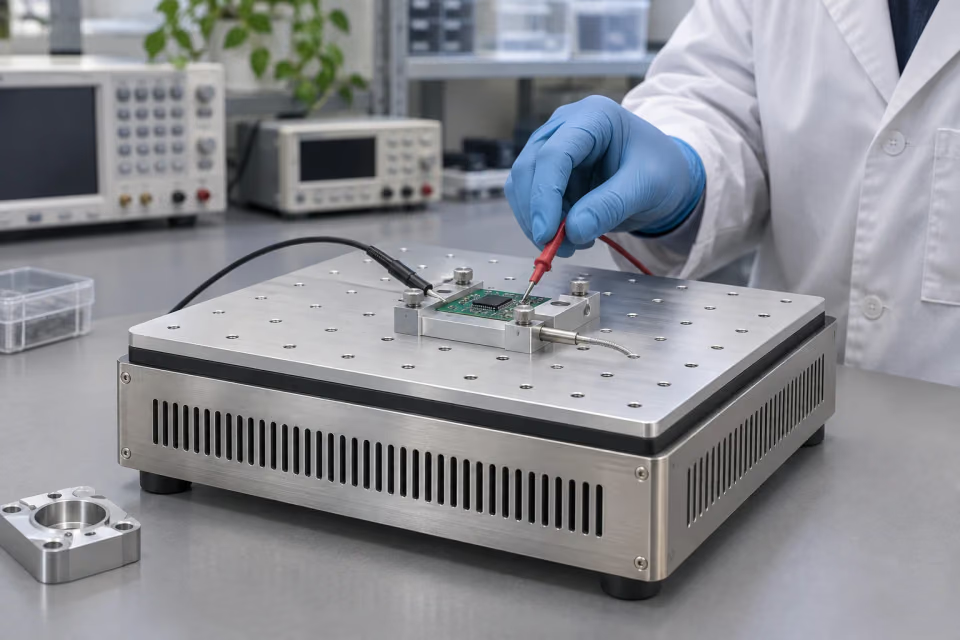
Application overview
In electronics testing, precision part inspection and laboratory sample handling, temperature is a condition that needs to be controlled and recorded. A workpiece leaving a previous process, a powered device generating heat or a sample arriving from a different storage environment can change the starting conditions for a test or process.
Arkmex Thermal TCP precision temperature control platforms use contact heat transfer to cool, heat and hold suitable workpieces, sample holders and component bases at temperature. The supplied controller adjusts output using sensor feedback, allowing the platform to condition and hold temperature under confirmed operating conditions and provide controlled thermal conditions for subsequent inspection, experiments or process transfers.
For projects that need to control an object's temperature directly, start selection with the actual task: what is being controlled, which temperature it must reach, whether it generates heat continuously and how much conditioning time is available.
How contact temperature control works
The TCP platform transfers heating or cooling to a workpiece through a contact interface.
A high-conductivity aluminum plate forms the contact surface. TEC thermoelectric elements are integrated underneath, together with insulation, a heat sink, fans and a SUS304 stainless steel enclosure.
During cooling, heat travels from the workpiece through the contact interface and plate to the TEC, then leaves through the hot-side heat-rejection system. For heating, the supplied controller switches heating and cooling output according to the setpoint and measured temperature. During temperature holding, PID control continues to adjust output using temperature feedback.
The same platform can therefore support different stages of a thermal process, including conditioning before inspection, controlled preheating and temperature holding during an operation. Confirm the cycle against the workpiece's permitted temperature, heat load and contact conditions.
Contact quality directly affects heat transfer. For flat workpieces, check surface flatness, thermal interface material and clamping. For irregular parts or containers, assess an adapter fixture that provides a defined heat-transfer path.
Cross-industry applications
Electronics testing
Electronics testing can start with the contact temperature of the device under test.
Resistors, amplifiers, small circuit modules and other electronic devices can exhibit different electrical characteristics at different temperatures. Testing needs to account for both external temperature conditions and the device's own heat generation.
For a device with a suitable thermally conductive contact surface, assess connecting the package underside, mounting base or thermal fixture to the TCP plate for performance testing at confirmed temperature points. After each setpoint change, confirm that the device has reached the required thermal state before collecting electrical data to establish comparable test conditions.
Key considerations include continuous heat load while powered, contact thermal resistance between plate and device, and electrical insulation. Where possible, record actual temperature near the device to relate electrical changes to temperature. Test probes, sockets and electrical measurement systems are configured separately for the project.
Sensor and optoelectronic development
Sensor and optoelectronic development needs temperature measurements that represent the working region.
For sensors, detectors and small optoelectronic modules being evaluated for thermal drift or temperature-dependent output, contact temperature control can form part of the experimental setup.
For example, secure a module base to a thermally conductive fixture, adjust the base temperature through the platform and record module output alongside temperature. Experiments can examine output differences at several temperatures, temperature changes after power-up and output fluctuations during temperature holding.
Locate measurement points so that they represent the functional region. Base, enclosure and internal sensing-element temperatures can differ; confirm these differences through measurement placement and settling time. For optical measurements, assess fixture interference with the optical path, as well as fan airflow and vibration effects on the measurement setup.
TCP provides temperature adjustment and holding. The experimental requirements define the thermal-drift assessment method and acceptance criteria.
Conditioning parts before precision inspection
Precision parts can be brought to a consistent starting temperature before inspection.
Workpieces experience different temperatures during machining, cleaning, handling and storage. For temperature-sensitive dimensional or assembly inspection, include the workpiece's condition on arrival in process control.
The TCP platform can be assessed as a conditioning station for suitable parts before inspection or for holding a specified temperature between processes. Establish appropriate contact with the plate, monitor workpiece temperature and proceed only when the specified conditions have been met.
Part size, mass, material and geometry affect thermal equilibration time. A thick-walled part or a workpiece with a small contact area may continue changing temperature internally after the plate has stabilized. If the part is removed for inspection, record transfer time and temperature changes after transfer.
Validate this application around workpiece thermal equilibrium and process transfer. Confirm permitted platform load, clamping and plate-protection requirements before use.
Laboratory sample conditioning
Sample holders or containers can provide a thermally conductive connection for laboratory sample handling.
For samples prepared, temporarily stored or measured at a specified temperature, assess the TCP platform for contact conditioning of sample holders, small containers or thermally conductive adapters.
Heat passes between the sample and plate through the container base, sample holder or dedicated fixture. After changing the setpoint, confirm actual sample temperature according to the experiment before sampling, observation or measurement.
Container material, wall thickness, sample volume and contact area all affect temperature response. The plate sensor measures its own location on the platform; confirm separately how long the sample interior takes to reach the target temperature.
For liquid samples, check container sealing, spill protection and cleaning requirements. Adapters, sample containers and material compatibility are determined by the particular experiment.
Materials research and property observation
Materials research can examine property changes within a confirmed temperature range.
For polymer sheets, coated test pieces or bonded samples, assess adjusting the specimen or holder temperature on the platform, then use suitable instruments to observe dimensions, appearance or other temperature-dependent properties.
Define where temperature is applied, how long it is held and how observations are made. Material thickness, contact conditions and state changes during heating or cooling affect the difference between sample and plate temperatures.
Test temperatures must meet both material limits and confirmed platform operating conditions. Experiments requiring a particular atmosphere, sealed chamber, observation window or mechanical loading need further confirmation of the complete setup.
Temperature specifications and control metrics
Operating range, control reference figures and maximum cooling capacity describe different requirements.
Current TCP series product specifications are listed below:
| Item | Specification and selection conditions |
|---|---|
| Operating modes | Cooling, heating and temperature holding |
| Platform operating range | −20–70°C; confirm achievable temperature points against ambient conditions, heat load and heat rejection |
| Controller setting range | −40–+120°C; check separately from the platform operating range |
| Control reference figure | ±0.1°C; confirm actual performance with the sensor, measurement point, load and environment |
| Model coverage | 7 models, with maximum cooling capacities spanning 75–600 W |
| Rated supply | 12 / 24 / 48 V DC, depending on model |
| Communication | RS485 for temperature data acquisition and monitoring of multiple devices |
The platform literature also gives temperature-difference references relative to ambient: approximately 25°C lower or 50°C higher at the plate. Check these references together with target temperature, ambient temperature and heat load during selection.
Distinguish the metrics when evaluating temperature control. Measurement accuracy describes deviation from a reference measurement; stability describes changes over time at a fixed point; plate uniformity describes differences between locations. Also check the difference between actual workpiece or sample temperature and the setpoint.
Use the catalogue ±0.1°C reference with its specific test conditions. Project acceptance should define the object, measurement points, instruments, load, environment and recording period so that the metrics correspond to the actual task.
Model selection and operating inputs
Define heat load and conditioning time before selecting a model.
An electronic module generating heat continuously and a metal part requiring conditioning only before inspection place different demands on the platform. The first needs continuous heat removal; the second also requires consideration of the energy and time needed to move from the initial to the target temperature.
Prepare the following information before selection:
| Information to provide | What it helps determine |
|---|---|
| Workpiece or sample material, dimensions, mass and quantity | Contact method, thermal capacity and required controlled area |
| Initial temperature, target temperature and permitted fluctuation | Thermal task and acceptance conditions |
| Continuous heat generation and operating state | Cooling requirement at the actual operating point |
| Conditioning and holding times | Transient response and continuous-operation requirements |
| Ambient temperature, humidity and installation space | Heat rejection, condensation and mechanical fit |
| Available DC supply and communication requirements | Model, supply capacity, wiring and monitoring configuration |
Catalogue maximum cooling capacity and maximum power consumption are listed separately. Confirm usable cooling capability at the target operating point, and check the supply and cables against the selected model's rated voltage, startup current and steady-state current.
Test-bench and OEM integration
Plan contact heat transfer, heat rejection and data acquisition together when integrating a test bench or OEM device.
Leave space for fan intake, hot-side exhaust, wiring and maintenance after installation. Recirculating exhaust air or a restricted heat-rejection path changes the platform's operating conditions.
Keep the contact surface flat and clean, and use the confirmed thermal interface material and clamping arrangement. Avoid scratches and concentrated loads on the plate to maintain contact quality.
The supplied TCP controls include temperature monitoring, automatic heating/cooling switching, PID control and abnormal-temperature alarms. An abnormal temperature can cut output and trigger an alarm; determine complete-equipment interlocks and shutdown behavior against the actual control sequence.
RS485 can collect temperature data and let one computer monitor and coordinate multiple devices. Before integration, confirm the protocol, device addresses, reading method and host-software configuration.
When the cold surface is below the ambient dew point, arrange condensation protection, insulation and drainage to protect adjacent electrical components. Include both temperature and humidity in validation for low-temperature operation.
Application validation steps
An effective application test observes both the plate and the controlled object.
Start with representative workpieces, samples and fixtures and create test records before judging whether the platform meets the actual task.
Use the following validation sequence:
Record ambient temperature, humidity, initial workpiece temperature, mounting and load state.
Set a confirmed target temperature and record temperatures at both the plate and the workpiece or sample measurement points.
Check time to reach the target, then temperature deviation and fluctuation during holding.
Add measurement points where needed and compare temperature differences between locations.
Repeat the actual loading, power-up or sampling cycle and observe temperature recovery.
An unloaded check establishes basic platform operation; a loaded test assesses suitability for the particular workpiece and process. After changing the fixture, contact material, workpiece quantity or installation environment, assess the effect on temperature control.
Frequently asked questions
Clarify these points during selection:
Can inspection start as soon as the plate reaches the setpoint?
Judge this against actual workpiece or sample temperature and thermal-equilibrium requirements, and define the waiting conditions in the process.
Can irregularly shaped workpieces be used?
First assess a thermally conductive fixture or adapter, checking contact area, thermal resistance, fixing method and permitted load.
Does a model with higher maximum cooling capacity necessarily meet the requirement?
Check target temperature, ambient conditions, actual heat load, contact interface and conditioning time together.
Can multiple platforms be monitored?
RS485 supports temperature acquisition and monitoring of multiple devices; confirm communication and software configuration for the actual connection.
Review your temperature-control requirements
Arkmex Thermal supplies TCP precision temperature control platforms for contact cooling, heating and temperature holding under confirmed operating conditions. For pre-inspection workpiece conditioning, temperature-dependent device testing or sample temperature holding, provide the target temperature, workpiece or sample details, heat load, conditioning time and supply conditions. We will use these inputs to check the model, contact interface and control configuration and clarify application-validation conditions.
Applications
Continue reading
Explore more Arkmex Thermal TEC cooling applications.