
Applications
Thermoelectric Cooling for Industrial Equipment
We configure TEC assemblies for local heat management in industrial electronics, inspection systems and compact OEM equipment. Define the critical component or enclosed air volume, its machine cycle and the installed environment before selecting an air, liquid or contact-cooling interface.
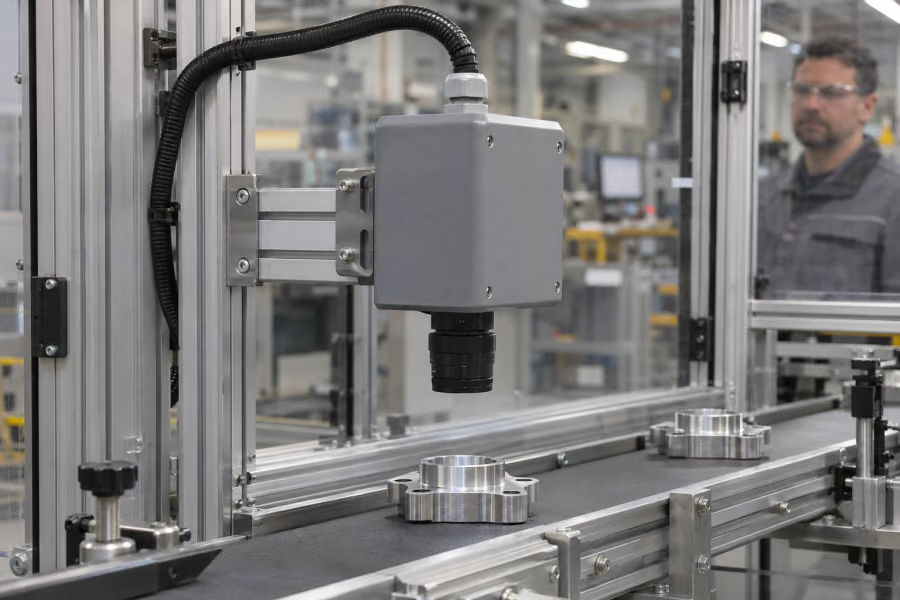
Define the local heat-load boundary
Separate the losses of the controlled electronics or inspection unit from heat entering through the enclosure and nearby machinery. Record idle, loaded and peak-cycle conditions, including continuous operation where required. These assemblies address local equipment temperature control; the suitability of whole-machine or room cooling requires a separate thermal assessment.
Match the interface to the machine
Air-to-air cooling can serve a defined enclosed air volume with separate internal and external flows. A contact interface suits a compatible fixture or workpiece, while a liquid interface serves a fluid-coupled load. Verify openings, seals and mounting details; an enclosure protection rating cannot be inferred from the cooling principle alone.
Size heat rejection for installed conditions
The hot side rejects the absorbed load plus TEC electrical input. Use the actual inlet-air temperature and installed airflow, including filters and enclosure restrictions. Allocate exhaust clearance and prevent recirculation. Account for fan, pump or controller losses according to where their heat enters the system, and validate the final operating point.
Design for vibration and maintenance
Check mounting loads and vibration in the machine's actual orientation. Provide cable strain relief and support hoses independently of the TEC interface. Reserve access to filters, fans and connectors. Define which thermal contacts and seals must be restored after service and repeat the relevant temperature checks after maintenance.
Coordinate power, feedback and fault response
Confirm available DC voltage, current limits and the selected configuration's start-up requirements. Define temperature feedback, enable signals and alarm handling with the machine controller. Evaluate sensor faults, overheating and fan or pump stoppage. The cooling subsystem does not by itself establish the machine's safety function or certification.
Validate the machine operating cycle
Run representative idle, production and restart sequences at the specified ambient limits. Measure the protected component or workpiece as well as relevant cold- and hot-side conditions. Agree on performance and fault criteria before acceptance. Supply the heat-load profile, enclosure drawing and electrical constraints so standard and custom options can be assessed on the same basis.
For equipment integration, review Air-to-Air Cooling Modules and Custom Solutions. Share the thermal conditions, installation drawing and electrical limits so we can assess a standard or custom configuration.
FAQ
Can these assemblies cool an entire room?
Their application here is local temperature control inside or alongside equipment. A room or large machine can have a different heat-load scale and operating boundary. Establish the load first and compare appropriate cooling technologies.
Is catalogue maximum capacity available inside an electrical enclosure?
Not automatically. Available cooling depends on the cold- and hot-side temperatures, installed airflow, sealing and electrical operating point. Verify the assembly in the enclosure under the intended duty cycle and ambient conditions.
Send Your Cooling Requirement
Leave your email and any project details you already have. Our team will review the information and reply with suitable TEC / Peltier cooling options.
Applications
Continue Reading
Explore more TEC cooling design articles from Arkmex Thermal.
Thermoelectric Cooling for Analytical Instruments
Select TEC assemblies for analytical detectors, optics and sensor modules. Review drift, measurement location, heat rejection and integration limits.
Next articlePrecision Temperature Control Platform Applications: Electronics Testing, Sample Conditioning and Inspection
Explore TCP contact temperature control for electronics testing, sample conditioning and precision inspection, with thermal interfaces and selection requirements.